

The intersection of Portland Avenue and East 34th Street in South Minneapolis, just blocks away from where the modern civil rights movement found its global focus, has once again become a flashpoint for a nation grappling with the boundaries of state power. On the morning of 7 January 2026, the fatal shooting of Renee Nicole Good, a 37-year-old mother and award-winning poet, by a United States Immigration and Customs Enforcement (ICE) agent, sent shockwaves through the Twin Cities and beyond.
The incident occurred during an intensified federal operation that had already drawn sharp rebukes from local leadership. What began as a routine day for a resident in a quiet neighborhood ended in a tragedy that has left three children motherless and sparked a fierce constitutional debate over the accountability of federal agents operating within local municipalities.
The Morning of 7 January: A Timeline of Tragedy
Reports and bystander recordings indicate that the confrontation unfolded shortly after 9:30 a.m. Renee Nicole Good was in her red Honda Pilot on Portland Avenue when she encountered federal agents who were reportedly struggling with a vehicle stuck in a snowbank. According to eyewitness accounts published by local media, the scene was chaotic, with agents providing contradictory instructions to the driver.
Bystander videos, which have since circulated widely across social media platforms, capture a tense moment where one agent appears to order Good to move her vehicle to clear the roadway, while another simultaneously demands she exit the car. As Good began to steer her vehicle forward, an agent positioned near the front of the SUV drew his service weapon and fired at least three rounds through the windshield. Good was struck in the head and pronounced dead shortly after being transported to the Hennepin County Medical Center.
Conflicting Narratives: Terrorism vs. Tragedy
The aftermath of the shooting saw an immediate and sharp divergence in official narratives. The Department of Homeland Security (DHS) quickly categorised the event as an act of “domestic terrorism.” DHS Secretary Kristi Noem and President Donald Trump defended the agent’s actions, asserting that the driver had “weaponised” her vehicle and intended to run over federal officers.
Conversely, Minneapolis Mayor Jacob Frey and Minnesota Governor Tim Walz have publicly challenged this framing. Mayor Frey, after reviewing available footage, described the federal account as “unsubstantiated,” asserting that the video does not show an intentional assault but rather a confused civilian attempting to navigate a high-pressure situation. This clash between federal assertions and local observations has heightened calls for an independent investigation that bypasses the internal review processes of federal agencies.
Who Was Renee Nicole Good?
Beyond the headlines and the political firestorm, those who knew Renee Nicole Good describe a woman deeply rooted in literature and family. Originally from Colorado, Good had recently moved to Minneapolis with her partner and six-year-old son. She was a recognized literary talent, having won the Academy of American Poets Prize during her time as an undergraduate at Old Dominion University.
Her mother, Donna Ganger, and other family members have expressed profound disbelief at the “terrorist” label applied by federal authorities. They describe Good as a compassionate individual who was not a part of any organised protest groups but was instead a “legal observer” or a concerned neighbor who found herself in the wrong place at a time of extreme federal escalation.
The Global Context of Law Enforcement Accountability
The killing of a U.S. citizen by federal agents on residential streets has international implications for how the world views American governance and civil rights. According to the United Nations Basic Principles on the Use of Force, law enforcement officials must exercise restraint and act in proportion to the seriousness of the offense. The intentional use of lethal force is only permissible when strictly unavoidable to protect life.
Data regarding law enforcement interactions highlights a persistent challenge in the United States. According to research from the Law Enforcement Epidemiology Project, a significant percentage of civilians who experience a threat of force from authorities are unarmed. Furthermore, the World Bank suggests that a country’s social stability is inextricably linked to the transparency and accountability of its security forces. When federal agencies operate with a perceived lack of oversight, it can lead to a significant erosion of public trust.
Statistical Reality of Federal Force
- Accountability Gaps: Federal law enforcement agents often operate under different oversight protocols than local police, frequently shielded by “qualified immunity” doctrines that make state-level prosecution difficult.
- Public Trust: Global indicators on governance suggest that transparency in use-of-force investigations is a primary driver of institutional legitimacy.
- Rising Tensions: The surge of 2,000 agents to the Minneapolis area marked the largest immigration enforcement operation in the region’s history, creating a high-friction environment where accidents and escalations become more likely.
Local Governance and Federal Supremacy
The shooting has reignited a debate over the “Supremacy Clause” of the U.S. Constitution and the extent to which state and local authorities can investigate or prosecute federal employees. Historically, the “Neagle doctrine” has provided federal agents with broad protection against state-level criminal charges if their actions were deemed “necessary and proper” for the execution of federal law.
However, the Minneapolis City Council and the Hennepin County Attorney’s Office have signaled an intent to pursue a rigorous investigation. The presence of clear, multi-angle bystander video provides a different evidentiary landscape than previous cases involving federal agents. The question remains whether the state of Minnesota can successfully challenge the federal government’s jurisdiction in a case involving the death of one of its residents.
The Humanitarian Impact on the Community
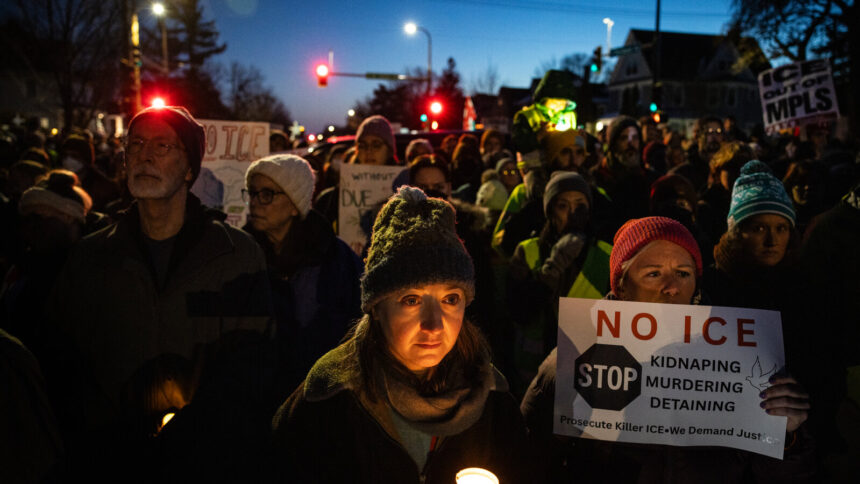
The psychological toll on the South Minneapolis community cannot be overstated. Located less than a mile from the site of George Floyd’s murder, the Portland Avenue shooting has reopened deep wounds. Hundreds gathered for a candlelight vigil on the evening of the shooting, demanding the removal of ICE agents from the city.
The humanitarian impact extends to the family unit; Renee Nicole Good was the primary caregiver for her youngest son. The sudden loss of a parent under such violent circumstances creates a ripple effect of trauma that the World Health Organisation (WHO) identifies as a significant public health concern. The focus on “national security” often overlooks these individual and communal costs of militarized enforcement in residential areas.
Conclusion
The fatal shooting of Renee Nicole Good is more than a localized tragedy; it is a profound test of the American legal system’s ability to hold federal power accountable. As the Federal Bureau of Investigation (FBI) and the Minnesota Bureau of Criminal Apprehension (BCA) conduct their parallel inquiries, the eyes of the nation remain fixed on Minneapolis.
Whether this case leads to meaningful reforms in federal law enforcement conduct or further entrenches the divide between federal authority and local sovereignty remains to be seen. What is clear, however, is that the name of Renee Nicole Good has joined a long list of individuals whose deaths have forced a necessary, if painful, re-evaluation of justice in the 21st century.